Tuesday, August 20, 2013

On Aug. 14th/20th I posted these photo's on twitter @DannyBaker0  https://twitter.com/DannyBaker0 and Google Plus https://plus.google.com/111828165923685267441 Photographing a subject from different angles can produce dramatically different results. I like both photo's but image 2 is much more creative than the other. Positioning and Composition are both essential to successfully make a photograph.

Image One Shinjuku

Image Two Shinjuku

Monday, May 13, 2013

Learn One Thing New Everyday

Imagine if you applied everything you learned about photography over the period of a year. As a challenge I will attempt to learn one new skill about photography everyday. Is this a challenge than I am able to meet. Maybe, but even if I fall short of my goal and learn 33% or 121 new tips/tricks about photography, just think how improved my skills as a photographer will be.

This idea came to me while browsing through a book about iPhone photography. I've taken several photo's with my iPhone and have used the panorama and HDR features, but didn't realize I could also zoom in on a subject.

Now this may be a Duh! moment for some, but I think most of us have done this at one time or another; realized there was something we could have been doing all along but haven't.

To zoom in, place your index finger and thumb together on the touch screen and spread them apart. To zoom out pinch together.

Also, a zoom bar will appear on the bottom
of the screen.

Another feature is to focus on a particular part of the subject, tap on the screen and a square will appear by tapping where you want to focus the square will automatically move.

By reading and studying you will find small tips and tricks to improve your skills, "I learned from that".


Monday, April 15, 2013

Photographing Small Animals at Eye Level.

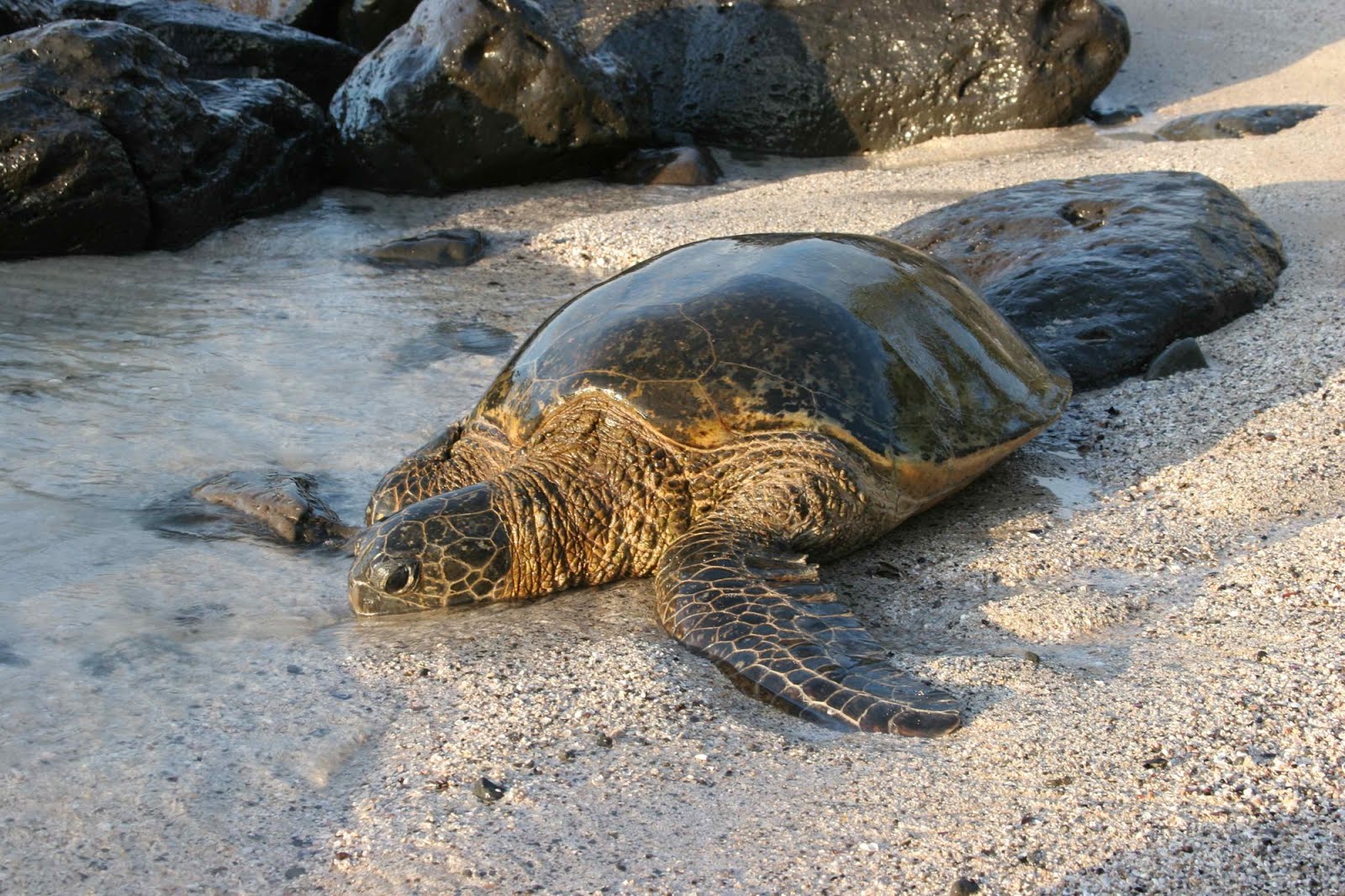
On Sunday I drove to the North Shore to photograph the Hawaiian Green Sea Turtle; even though I knew it was going to rain. Sure enough when I arrived it began to rain. I grabbed my gear hoping there would be a short break when the rain would stop; and  walked to where I knew the sea turtles would be relaxing. I hunkered down beneath a small tree with my poncho draped over me and my gear, and waited. A small window of opportunity arrived and that's when I was able to capture this picture.
Hawaiian Green Sea Turtle
Because the turtle was facing the ocean this would assist with adding character to the picture. I needed to turn my back on the ocean, which is breaking the rule of never turn your back on the ocean, and dropped to my knees so I would be eye level with the turtle. When photographing small animals or children, instead of photographing them from the dominant position, (basically standing above them), take the photo at eye level. I think you will be pleasantly surprised.

Tuesday, April 9, 2013

What's All The Buzz About Social Media

As a participant in social media, whether it's Twitter, Google+, or Facebook, I often ask myself, what's all the buzz about social media. As a photographer I mainly use Twitter and Google+, so I only gathered some facts about these two platforms. Facebook, Linkedin, Stipple, Pinterest and several other social media sites are worth a look.

The purpose of this blog is informational only. Here are some interesting facts to generate discussion; or  just to get you thinking. 

(Disclaimer: It appears the sources I cite are reputable and may be a little dated, but I'm sure they are not too far off the mark).


Twitter 

- In the U.S. there are over 140 million users, Hong Kong is the fastest growing, and in the U.K. there are over 10 million users.
(Source: Media Bistro and Infographics).

- 69 % of tweets are suggested by friends, whereas 47% are on line searches.
(Source: Web Analytics World).

- The average user follows or is followed by 51 people. 16% have no followers, no tweets, and no friends.
(Source: Diego Basch Blog).


Google +
- Web sites using the 1+ button generate 3.5 times the visits than those without the button.
(Source: Hub Spot).

- Google + users average 12 minutes per day per visit.
(Source: Jeff Bullas).

-Google + is used primarily by college students and software developers. 63% are men.
(Source: Remcolandia).

Saturday, March 30, 2013

Patience of a Hunter "I learned from that"


Wildlife photographers and hunters have a lot in common. One of the similarities is patience. Ralph Waldo Emerson once said, "Adopt the pace of nature: her secret is patience". As a wildlife/nature photographer it is the essence of what I do. Whether waiting for the afternoon light, feeding time, or waiting for mother nature  to present the beautiful wildlife she has created; it is patience that allow me to capture my most rewarding photographs. It is important to have patience, but it is equally important to learn the habits, and habitat of the wildlife you will be photographing.

While on the North Shore of Oahu, Hawaii USA I had to wait several hours to capture this photograph of the Hawaiian Green Sea Turtle; commonly known as Honu in the Hawaiian language. Timing and lighting were essential, but more importantly, patience. After several hours of basking in the sun, the sea turtles’ shell will become very dry and it isn't as appealing as when its’ shell is wet. There are two occasions when you are able to capture this moment, when the sea turtle first arrives on shore, or prior to going back to sea. Coming on shore it’s obvious the shell will be wet, but returning the turtle moves slowly, and the incoming waves will splash over the turtle, which will allow you enough time to capture one or two shots. Sitting and photographing the sea turtle for hours,and learning their behavior was essential. It was patience that taught me this valuable lesson.  “I learned from that”.

Tuesday, March 26, 2013

Photographers Insanity, I Learned From That

What is the definition of insanity? "Doing the same thing over and over and expecting different results". In life this is true, but as a photographer I realized I can photograph the same scene or subject, and get different results every time.


Exhibit A
Exhibit B


Both photo's were taken at the same location, but at a different time of the day. The first photograph was taken in 2006 the second in 2013. Each photograph evokes a different emotion. By changing the position of the two small islands in the frame of the picture, it will naturally produce different results. Weather also plays an important role. The reason I decide to blog about this topic, sometimes I say to myself, I've photographed this before, I want new material. But in reality I haven't even begun to scratch the surface of this location. If you asked ten photographers to photograph this scenic location you would get ten different interpretations. And that's the beauty of photography. "I learned from that".

Sunday, September 11, 2011

Photographing Snow Monkey's Japan 2011 Photo Project Part V

This is the final blog of my five part series about my Japan 2011 Photo Project. I hope you enjoyed reading about my adventure as much as I had writing about it.
The final leg of my journey was going to Nagano Prefecture to photograph the Japanese Macaque, also known as the snow monkey. The snow monkeys are mainly found on the islands of Honshu, Shikoku, and Kyushu. I went to Honshu to Joshin-etsu Kogen National Park, in Nagano Prefecture.

Shibu Onsen
The day my wife and I departed Tokyo, it was cloudy, and it seemed rain was imminent. We were traveling approximately 3 hours from Tokyo, and I was hoping the weather would be better. As we rode the train it seemed luck wouldn't be on my side. However, the closer we got to our destination the sun began to break through, but when we arrived, it was raining, just as I believed it would.
Japanese Macaque
We walked around Shibu Onsen a small village near the park, and decided to eat some cold soba. Zaru Soba is a Japanese noodle served on a zaru (draining basket made from bamboo), with a chilled dipping sauce, green onions and wasabi. We rode the bullet train from Tokyo to Nagano, changed to a local train, which took us to Shibu Onsen. Was this going to be the highlight of our long trip. As I pondered while eating, my wife said we should push on and go to the Jigokudani Yaen-Koen Park where the snow monkey hangs out. Not sure how much further we needed to travel my wife asked the waitress for directions and she suggested we take a taxi to the park entrance, from there we would need to walk the remainder of the way. The reward was much more than I expected. At first I was reluctant but decided to listen to my wife's advice and can say I'm glad I did. "I Learned From That".

Japanese Snow Monkey

Sunday, August 28, 2011

Learning From Sources Other Than Photography

Many times we look to the experts in our chosen field or profession for sage advice. Although this is a wise choice, we can also learn from other professions. During the summer I watched the Next Food Network Star. I am a competitor, and enjoy watching competitive events. As the show continued throughout the summer I watched as each contestant dealt with their shortcomings, and how they reacted to their successes. The panel of judges gave valuable advice, whether it was how they presented themselves and the food they prepared; or just giving simple business tips on how to market what they were presenting to the Food Network audience. Take the food out of the equation, insert photography, and the advice given by the panel; plus the lessons learned is something that is very applicable in everyday business/marketing.  "I Learned From That".

Japan 2011 Photo Project Part IV Kyoto


Kyoto, Japan, a city known for it's numerous temples, is a very modern city, but still has that old country atmosphere. One of the most visited temples in Kyoto is Kinkaku-ji, or better known as the Golden Pavilion. The setting here is very serene and beautiful. Because Kyoto is a tourist destination it is very organized and easy to get around. 
After a long day of photographing, I went back to the hotel for some much needed rest. Carrying around a backpack full of equipment and a tripod, can wear you down. For some reason, I have in my head, that I need all my camera gear for that unexpected photo opportunity that will be my claim to fame. "Always be prepared"! With some much needed rest my wife and I, who has endured many of my photo excursions, and never complains, decided to go for a short walk. I chose to leave the hotel without my camera. I can only imagine what goes on in the mind of someone who is not as compassionate about photography as the person who is. After walking a few blocks, low and behold is a Geisha posing for anyone and everyone who wants to take a picture. One of my dreams is to photograph a Giesha in a typical Japanese setting. Wow! If only I had my camera, my dream would have been realized. Not to be discouraged, I ran back to the hotel to get my camera. Unfortunately when I returned the friendly Geisha had gone. I searched the area but the sun had set on this opportunity.   

What lesson can be taken away from my misfortune? I'm always torn when I have someone with me that is not interested in photography. Do I subject them to, oh wait he's taking another photograph, or do I not be selfish and let opportunities go by. There is a balance, but it depends on the situation, and the individual. If I was on my own to strictly photograph, then I would not hesitate to take my camera.  But when others are accompanying you that have different reasons to be there, then it's time to strike a balance.  If I had it to do over I would have done it differently, but this is lesson that I can say "I Learned From That".


Sunday, August 21, 2011

Japan 2011 Photo Project Part III Tokyo

Tokyo Metropolitan Building
Tokyo, Japan one of the largest cities in the world, with a population of over 13 million people; this is a city that has something for everyone. During my two week adventure, Tokyo was my base of operation. I ventured out and returned to Tokyo. If I had the time I could have stayed in Tokyo for two weeks and wouldn't have skimmed the surface on photographic opportunities. Districts like Shinjuku, Harajuku, Roppongi, I could go on and on.
Shibuya

Hie Shrine Torii
Before my trip to Japan I purchased a Gorilla Tripod to use, when I wanted to lighten my load, and bring just a camera and one lens. I didn't remove it from its' original package but should have. One day I decided to take a trip to the Hie Shrine. When I reached my intended destination, I took my Gorilla Tripod out of the package and realized it didn't have an attachment so I could mount the camera to it. Without my tripod it was going to be difficult to shoot certain scenes. Even with an image stabilizing lens holding the camera by hand just wouldn't produce a photo that was acceptable. One particular scene I wanted to shoot was the long tunnel of Torii.  Without my tripod I sat the camera on the ground, set the timer, but I still needed to tilt the camera forward.  Because I had to tilt the camera by hand this was very unstable and produced some shake. The photo of the Torii I included in this post is not what I envisioned.  Unfortunately I missed out on an opportunity to produce a quality photo.  I'm not sure why the company that manufactures Gorilla Tripod doesn't include the necessary attachment to mount the camera on the tripod, but whenever I buy new equipment, whether Hi-Tech or Low-Tech; I will ensure it has all the necessary gadgets that are needed to operate that piece of equipment. "I Learned From That".

Sunday, August 14, 2011

Japan 2011 Photo Project Part II Hiroshima

A-Bomb Dome
As I travel on, I set out for Hiroshima and learn a valuable lesson that can be applied to photography, or life in general. Sometimes when you set out to photograph a particular scene, object, or whatever, you do so with the intent of capturing the best photograph possible. Realizing only during the shoot there is something significant about this object.

I realize that Hiroshima is significant, but when you are far removed from what what occurred; you may have a point of view that might not be changed until you photograph that scene or subject.

Photography is truly an art that has many facets. So when we initially take on the art of photography, generally speaking; we try to become technically proficient with our tools (camera, flash, ect.). I can attest to the fact when I first began photographing, I was more concerned with the settings on the camera; that I was so preoccupied with selecting my settings, I couldn't focus on photographing my subject.

As with most things, the more we do something we begin to take control and eventually it becomes second nature. Once this occurs you can begin to focus on your subject and your creativity begins to open up.  My initial reaction was to go directly to the A-Bomb Dome but I chose to go to the museum first. Below is display model of
Hiroshima Before The A-Bomb
Hiroshima After The A-Bomb
Hiroshima before and after the A-Bomb. Throughout the museum were other displays that are very graphic and sometimes unnerving.  During this whole evolution I continued to think about what I've often heard said, "Because of the A-Bomb many lives were saved".  Although a political point of view can be drawn from my blog this is not my intent. After viewing and photographing the museum and the A-Bomb Dome, I understand with clarity why the people of Hiroshima and Nagasaki dislike nuclear weapons or any type of nuclear facility. I don't have to agree with their point of view, but I certainly respect it. I learned from that.

Sunday, August 7, 2011

Japan 2011 Photo Project

First, it's been a while since I posted a blog so I'll try to do a better job and post at least once a month.  Second, I'll post this blog in five parts.  Because of the amount of information, the blog will be too long.

I travelled to Japan and visited Tokyo, Hiroshima, Kyoto, and the Joshin-Etsu Kogan National Park. There is so much to photograph and two weeks is just not enough time.  Most of my travelling was either by bus, train, or taxi and sometimes a combination of all three. Although I've visited Japan many times this is the first time I used the Japan Rail Pass (http://www.japanrailpass.net/).  The Rail Pass is issued by JR Rail and available to visiting foreigners only. You must purchase the pass in your country and it will be exchanged at a JR office. It can be used for unlimited travel on the Shinkansen (Bullet Train) with a few restrictions, but none that are inconvenient considering the cost you would pay without the pass.

One rail pass cost $362.82 (USD) or  28,300 Japanese Yen. Just to put it in perspective the regular unreserved one way fare to Kyoto is 12,700 yen. I travelled to Kyoto, Fukuyama and then by car to Hiroshima, and Nagano.

Not sure why I never used the Japan Rail Pass before but I'm glad I did and the next time I travel to Japan I will make sure I purchase another rail pass. Keeping with my theme "I Learned From That".

Please visit my web site at www.dannylbaker.com and you can follow me on Twitter http://twitter.com/#!/DannyBaker0 Thanks!

Monday, May 24, 2010

Canon 7D DSLR


I'm going to be a little braggadocio, I just purchased the Canon 7D. Wow! What a camera! Although the 7D has a lot of new features including 1920 X 1080 full HD video, I mainly purchased it to upgrade from my Canon 20D; which has served me well.

I'm also teaching myself the art of High Dynamic Range (HDR) photography. I am so lost, I won't even attempt to give any hints, tips, or techniques on how to perform this highly specialized skill. A couple of recommendations that I found will get you in the ballpark is use a tripod, and whether you bracket three consecutive shots or more shoot them as quickly as possible.

The Buddhist Temple is my first attempt and the Hawaii Theater is my second attempt. You can be the judge but I need a lot of work.

As my new skill continues to evolve I will post my work. You can visit my website at http://www.dannylbaker.com/

Sunday, March 7, 2010

Missed Opportunities

Many times when we least expect it, an opportunity will present itself; and most times we realize it but fail to act. Other times it maybe staring us in the face but don't realize it until someone else acts on it. Kind of like the T.V. commercial "Wow I could of had a V-8!".

I have experienced both of these situations but would like to share one of my most recent missed opportunties.

While sitting in a newly opened coffee shop, at a local mall, waiting for my wife to complete her shopping; I noticed the walls were devoid of any art. From my experience, this very unusual for coffee shops.
Although the walls were bare, and painted a bright white, this made a pleasant atmosphere. As I continued to sip on my coffee, I wondered, was this the owner's intent? Or, did they simply run short on cash and decided to focus on their product?

As I sat and watched people coming and going, I noticed a gentleman that was very busy; and it appeared that he was either the owner or the manager of this coffee shop. As he was hustling around, greeting customers, and talking on his cell phone, I chose not to bother him. My reasoning, was I didn't want to interupt him and quite possibly damage any future negotiations with him.

Aproximately three weeks later I returned to the mall and checked out the coffee shop, and my questions were answered. The owner had placed on the nice bright walls some paintings. In business there is a fine line between being overly aggressive and aggressive. What I should have done was left a business card with him at least giving me a slight chance; but instead I chose to do nothing which gave me no chance.

So my reasoning proved to be wrong. Basically, I am in the same position that I was trying to avoid. Always give your potential customer the opportunity to say no. I learned from that.

Monday, February 1, 2010

PHOTOGRAPHING NEW BORN BABIES


Photographing new born babies is probably 90 percent luck and 10 percent skill. Although I am far from being an expert in this particular skill, the one time that I did was far from successful. But, what I learned is portrait photography requires attention to detail and always being mindful of what is constantly taking place while trying to photograph your subject(s).   Below are some tips that will help new photographers especially those that will be taking portraits   of  new born babies.
Although the photo's shown are not bad, had I taken my own advice, these could have been much better. I'll let you be the critic.

1. When photographing new born babies, ask the parents when is the best time of the day to photograph the baby. Parents know baby's personality, and when baby is generally on his/her best behavior. For example, early morning or after being fed.
2. Because of the moving around and setting up, you must be quick to capture the moment that will suddenly present itself.
3. Generally allow 45 minutes to an hour at most, because new borns will not tolerate much more and it's probably very stressful.
4. Whoever coined the phrase patience is a virture much have been a photographer, don't be too quick to take the picture. Set it up making sure that everyone is prepared so when baby does make that special moment you are ready.

As always please visit my web site at http://www.dannylbaker.com/ or if you have any comments or suggestions you can email them to me at dannylb@lava.net

Saturday, January 2, 2010

Knowing Your Clients Needs and Taking Care of Them

The business side of photography is a key element to becoming a successful photographer. It is an ongoing effort to find and keep clients. That is why "Knowing your clients needs and taking care of them" both during and after you've completed the project; is critical to the success of your business.

While photographing a model for an advertisement, I didn't fully understand that advertisement photography needs to be approached a little different from regular model photography. Although my client stated they would like to use these photographs for an ad, it was still incumbent on me to get the specifics. In addition to being a photographer I need to be a good sales person, and uncover the needs of my clients. In sales sometimes a customer will not be as direct or forthcoming as we would like. Not that the client/customer does this intentionally it's just the way life is.

So, by being very specific, and asking direct questions such as, in what way will you use the ad. Or will the add include text within the photograph, and how large or small will the ad be. Once you've asked those intial questions then, you can ask more open ended questions so the client will elaborate on how they envision the ad.

Although this is not all inclusive these are just a couple of tips that can be useful. Being a salesperson can be very difficult, but if you belive in your product it makes it significantly easier to wear your sales hat as a photographer. Please go to my web site at http://www.dannylbaker.com/ and click on the "Project" button to view a sample of my work that was used in Tiki Magazine.

Thursday, November 26, 2009

Taking good notes is an essential part of photography


I recently was reviewing some of my photographs that I took earlier in the year. I opened this particular folder and remembered the day I took the photo's in the folder, but was uncertain how the pictures shown were taken. It became clear to me after carefully reviewing these abstract non pictorial objects what I was looking at; it was a creation I made using photoshop. How I got to this point is not so clear. The original image I took was a flower. Wow! Had I taken copious notes while performing this procedure I would be able to duplicate it at some point should I choose. Take good notes while photographing and while working in photoshop or as soon as possible once you've completed your project. I learned from that. Please visit my website at www.dannylbaker.com and share any comments or thoughts you may have.

Saturday, June 6, 2009

Finding a Model


Finding and hiring a model is very difficult, especially if the photo shoot requires a model that specializes in a specific area. The model I was looking for had to dance hula. But if you have limited resources available, and little to no experience with photographing models; where and how does a photographer go about searching for a qualified model.

I was fortunate to find an excellent model on my first attempt. As a side note, I would not do the Hula Dancer any justice by labeling her a model only. In reality she is an artist, she performed to a level of experience far beyond what I expected.

As I mentioned, with limited resources (e.g money) that may restrict you from hiring a model agency, the only other option I could come up with is search the Internet. I'm sure there are many options available but these were the two that I thought were most practical and convenient.

I'm not promoting a particular website but craigslist.org is the website that I chose only because it is a well known website. I placed an ad, (which is free by the way), and soon I was receiving inquiries about my ad.

The ideal approach to hiring a model is to have a written plan of action. However, in this case it was my first time venturing into this area so I relied on my life's experience. This approach is not all inclusive, and is not detailed, but it is a starting point that can be tailored to your needs.

1. Search: Approach model search as if you were hiring someone to work for you, because you are.
a. Post ad.
b. Set-up appointments to responses.
c. Conduct interviews.
d. Make selection.
2. Second interview with selectee: Know what you want the model to do.
a. Set guidelines/discuss specific clothing or outfits.
b. Set time/location.
c. Sign contract.
3. Preparation for the shoot:
a. Visit location prior to shoot.
b. If possible use assistant.
c. Prepare equipment.
4. During the shoot: Be assertive but not too demanding.
a. Talk with model to make them comfortable.
b. Be specific and communicate with model.
c. Take plenty of photographs.
d. Take written notes if time permits or make mental notes and write them down as soon as possible.
5. Conclusion: Thank model and provide any additional information (e.g. Portfolio, Photo Package).

These are the basics that I found I needed to conduct a successful model search. Unfortunately these were lessons learned during and after the search and I consider myself very lucky. I learned from that and hopefully you will too.

As always happy photographing and please make comments or suggestion. You may visit my website at www.dannylbaker.com

Thursday, May 21, 2009

I Learned From That

All photographers face dilemmas, especially when you are just beginning your photography business. How you deal with those dilemmas will determine how successful you are. I recently faced such a dilemma. Imagine you've just finalized all the specifics and you are ready to shoot. I was photographing a hula dancer at Laniakea Beach. The day of my photo shoot it was overcast and the rain was impending. As I stated in a previous blog, in Hawaii, if you don't like the weather just stick around for awhile and it will change. However, this was not going to be the case, the whole state was covered by clouds. Because of my eagerness, and wanting to get the experience from this particular shoot, I decided to move forward as if I were going to complete the session. But I knew if I did, it wouldn't be exactly what I wanted, and I probably would not be satisfied. All of these things were racing through my head and I needed to make a decision. But, I didn't want to rush to judgement. I had scheduled the photo shoot with a professional hula dancer on Thursday but she had overlapping commitments so we rescheduled for the following Tuesday. Because I had little to no experience with photographing models I had to rely on my instinct or should I say better judgement. Fortunately the model I was working with was very flexible and easy to work with. She called me the day of the shoot to inform me it was raining near the location we were going to do the photo shoot. Both of us agreed it would be better to delay the photo session until the following Monday. While listening to a photography podcast recently the photographer that was being interviewed said he waited for 12 years to get the particular photograph he was looking for. Hopefully I wouldn't need to wait that long but I realized that although we would like to shoot regardless of the situation sometimes a little patience make it worth the wait. To see some of the photographs I took please visit my website at www.dannylbaker.com I learned from that.

Friday, May 15, 2009

I learned From That


One of the most valuable tools in life is learning from our mistakes. Sometimes retrospectively we would have preferred to learn in another way. However, a hard learned lesson is like a gift that keeps on giving, you remember these lessons long after you've made the mistake.

If you haven't already read my blog I posted on May 9, 2009 ("Composition and Position are Very Important") do. But just to summarize, so this will help create the connection; while on self assignment photographing the Green Hawaiian Sea Turtle, another opportunity presented itself and I failed to take complete advantage of the situation. My composition was correct but my positioning was not where I would liked to have been.

The photographs shown above illustrate what I'm trying to convey. The first being my initial shot, and the second a redo at a later time and date, show similarities but are very different in my positioning. In the first photograph the top right 1/3rd edge of the photograph you can see a small portion of the cross beam high line wire pole. I erased the high line wires using photoshop, but as you can see this was not necessary had I positioned myself in a different spot.

With that said I do like my second photograph but the first photograph was taken during a hazy day which added to the character of the photograph. unfortunately this was something I could not duplicate in the second photograph.

I learned from that, "Lessons Learned Continue to Teach". As always please make any comments or observations on this or any of my blogs. Happy photographing!